





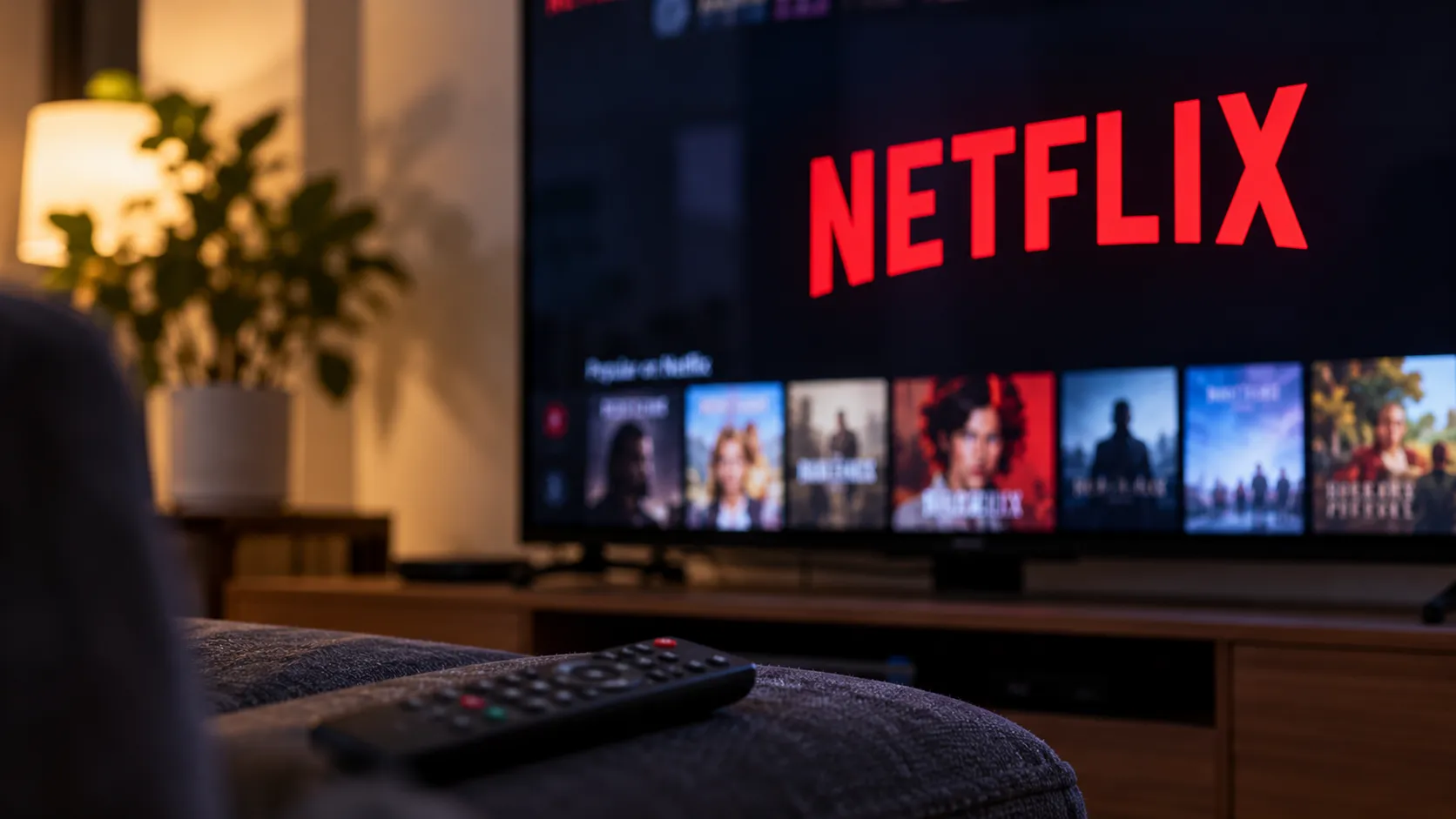
Netflix reaches 72% of American adults, making it the most widely used streaming platform in the country. Its share of total U.S. television viewing still fell to 7.8% in April, its lowest level since May 2025, per Nielsen data. Nearly everyone has it. Not everyone is watching.
That gap is the context for a report published this week by TheWrap and Digital Trends, sourced to The Wall Street Journal, that Netflix executives have been debating whether to introduce always-on, genre-specific channels: streams that play content continuously without requiring the viewer to choose anything. But these are reported internal discussions, not a launched feature or announced strategy. They may lead nowhere.
What they reveal is worth examining anyway. When a streaming service at full market penetration starts studying cable's viewing mechanics, it isn't being sentimental. It's responding to a specific economic problem: a market where adding subscribers gets harder has to find other ways to grow, and the most direct path is getting existing subscribers to watch more. Cable solved this same problem decades ago, largely by making the passive default the product. Netflix is looking at the same solution.
Why Netflix live TV channels are really about attention, not nostalgia
Always-on channels and live television are not the same thing. Live television means real-time events: sports, breaking news, award ceremonies. Always-on channels are a scheduling format: pre-recorded content that streams in continuous sequence, playing regardless of whether the viewer made an active choice to start it. It's a cable network running a procedural drama marathon on a Wednesday afternoon. Nothing is live. It just doesn't require a decision.
Netflix's current interface is built for an active chooser: someone who opens the app with a specific kind of energy, scrolls the catalog, and selects something intentional. A substantial portion of television viewing has always been less deliberate, though. Background noise while cooking, children's programming looping in the next room, something comfortable running while attention drifts. That mode of use is structurally invisible to Netflix's on-demand interface. Internal concern that people aren't watching enough maps closely to what product designers call choice paralysis: an overabundance of options that creates friction rather than engagement.
Netflix's own viewing data already reflects the difference. Ms. Rachel, a children's series purpose-built for habitual, low-stakes repeat viewing, ranked seventh among all Netflix titles in the first half of 2025, accumulating 53.4 million views, per TheWrap. That performance doesn't come from word-of-mouth or prestige; it comes from daily routine.
Meanwhile, a live celebrity roast drew 13.5 million viewers in a single week, ranking first across all streaming platforms that week per Nielsen, also reported by TheWrap, because the content was time-specific: you watched it then, or you missed it. Both behaviors are ones that an always-on channel is designed to capture or replicate. Neither fits naturally into a scroll-and-choose interface.
One nuance worth holding here: reports of audience declines in second seasons for shows like Beef, One Piece, and Avatar: The Last Airbender, cited by TheWrap, shouldn't be read as evidence of a platform-wide crisis. Franchise decay is endemic to television across every medium. The more useful reading is that Netflix cannot bank on returning hits alone to generate consistent viewing across a full year, which makes the passive viewing modes it currently underserves an identifiable area for growth.
That passive viewing opportunity points directly toward a financial calculation, not just a UX one.
More minutes, more ad revenue: the economics that make passive viewing strategic
The advertising math for always-on channels is straightforward, and it explains why this isn't simply a product experiment.
On-demand viewing generates ad inventory when a subscriber makes a choice and presses play. A continuous channel generates ad inventory for as long as someone leaves it running, whether they're actively watching or the TV is simply on in the background. The value difference between those two behaviors to an advertiser is substantial: a viewer who watches one episode and closes the app is worth significantly less than one who spends two hours in the same interface without making another decision. Always-on channels are, structurally, an ad-load expansion mechanism dressed as a viewing convenience.
Netflix brought in roughly $1.5 billion in advertising revenue last year and has publicly projected that figure will approximately double in 2026, per Digital Trends. That target likely depends in part on getting more viewing time from existing subscribers, especially in a market where 83% of American adults already use streaming and only 10% have never used it at all, according to Pew Research Center. Netflix's January 2026 annual report shows live programming is already a stated growth area, alongside video podcasts and gaming, with the World Baseball Classic cited as an early live initiative. Always-on genre channels would extend that logic from discrete events into everyday inventory.
Prime Video introduced ads by default in January 2024 and offered subscribers a $2.99 monthly ad-free upgrade. In April 2026, Amazon renamed that upgrade Prime Video Ultra, added features, and raised its price to $4.99 per month, per DecodeEcon. The ad-free experience that was once standard became a paid upgrade; that upgrade now costs more than the opt-out it replaced. The practical direction of this industry is already clear: more passive viewing, more ad exposure, and more revenue extracted per subscriber without adding a single new account. Netflix's always-on channel discussions fit exactly that pattern.
From channel to gateway: how Netflix live TV bundling extends the same logic
Always-on channels solve for idle attention; bundles solve for interface dominance. That's why both ideas are surfacing together, and why they belong in the same conversation.
The same reporting that surfaces always-on channels describes a larger ambition: Netflix potentially becoming the interface through which subscribers access and manage other streaming services, with Peacock reportedly among the candidates for bundling inside the Netflix app, per Digital Trends and TheWrap. Prime Video and Apple TV+ already offer app-based add-on subscription models, per TheWrap.
The connection to always-on channels isn't incidental. A platform that becomes the default television experience, the thing you leave on, the interface that's always running, is also the platform with the most use to sell you access to other services. The always-on channel and the streaming bundle are the same product idea at different scales: both are designed to make Netflix the television, not an app you open and close.
The market conditions make this understandable. The average U.S. household now subscribes to four streaming platforms, and the combined monthly cost increasingly resembles the cable bills those households canceled, according to a Vanderbilt Law School analysis from earlier this year.
The 28% of Americans who currently subscribe to both streaming services and cable or satellite is still a significant share, according to Pew Research Center, demonstrating that viewing behavior was never a clean binary. Audiences already live across multiple services simultaneously. A single interface that manages that complexity has genuine appeal; the platform that controls the interface controls the purchasing decisions inside it.
Similar attempts to consolidate sports distribution have already drawn regulatory and legal scrutiny. The proposed Disney, Fox, and Warner Bros. Discovery sports service previously drew antitrust scrutiny and was blocked by a federal judge before the companies abandoned the original Venu Sports venture in January 2025.
The pattern is established, though: the same consolidation that simplifies the user experience tends to concentrate platform power in ways that draw regulatory attention, especially where live sports, scarce, time-sensitive, and uniquely valuable, are involved.
What this means for how you'll actually use Netflix
Whether or not any of this produces a product announcement, subscribers have reason to track a few concrete shifts in how the service evolves.
The day-to-day experience of Netflix is likely to move toward less active decision-making and more ambient use. More autoplay-style defaults, content that starts without a deliberate choice, fewer moments where the interface asks you to pick something. For viewers who find the current scroll exhausting, which is, based on Netflix's own reported internal concerns, a real and common experience, that's a genuine improvement. For viewers who use Netflix as a deliberately curated watch list, it will feel like the service is optimizing around someone else's habits.
More passive minutes mean more ad exposure. Netflix's ad-supported tier already exists; always-on channels would likely expand the inventory available within it, following the same economic logic Amazon has already applied. The international precedent is already running: Netflix recently partnered with French broadcaster TF1 to bring live programming, including news, to subscribers in France, per Digital Trends. Executives have also reportedly discussed bidding for the 2030 and 2034 FIFA World Cup broadcasting rights, per Digital Trends. The TF1 partnership and the World Cup discussions are worth watching as indicators of how quickly the always-on logic moves from internal debate to deployed product.
And if bundling materializes, the simplicity of one interface managing several services will come paired with one interface controlling several purchasing decisions. That is not necessarily a bad deal for subscribers. As the Vanderbilt Law School analysis notes, bundling can produce lower per-service costs and a better user experience. However, the history of platform consolidation suggests the terms can worsen over time.
Streaming services that have run out of new subscribers to add eventually start optimizing the same way cable did: for retention, habit formation, and the monetization of time already spent inside the service. Netflix isn't revisiting cable out of nostalgia. It's arriving at the same destination by the same economic logic, one always-on channel at a time.


Comments
Be the first, drop a comment!