





Fox Roku Acquisition: How Fox Gains Control of 100M TV Households
Fox Corp. agreed Monday to acquire Roku for approximately $22 billion, gaining a foothold in the operating system running inside more than 100 million streaming households globally. As Deadline framed it yesterday: "Fox Corporation is buying an operating system." Analysts and executives have described it as a distribution and ad-tech play rather than a content-library acquisition, and the numbers bear that out.
Roku boasts distribution in more than 100 million households worldwide, including half of all U.S. broadband households, Sportico reported yesterday. The deal is expected to close in the first half of 2027, per TheWrap.
What Fox is actually buying in the Fox Roku deal
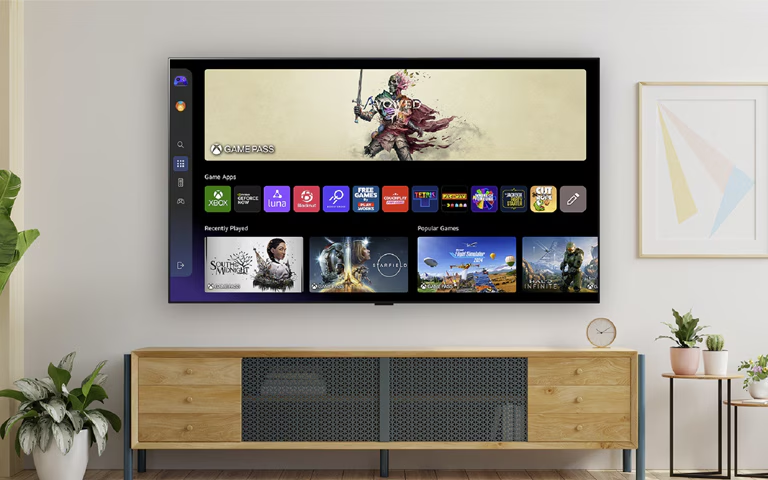
Start with the home screen. When a Roku user turns on their TV, the first thing they see is a large marquee tile sold to outside advertisers and a personalized carousel of recommended content. Disney and Peacock both pay to place promotional inventory there, Deadline reported yesterday. Fox now owns that surface.
Roku CEO Anthony Wood told investors the carousel is personalized based on what users are statistically most likely to watch or buy. "Having more properties that generate more revenue and being able to decide when to promote them and when not to promote them will result in overall more revenue being generated by the homescreen," Wood said, per The Verge.
Beyond the home screen, apps including ESPN, Paramount+, NBA League Pass, and MLB Extra Innings currently pay fees to be distributed through Roku's platform. Fox will now control that layer, Sports Business Journal reported yesterday. Roku held 44% of all connected-TV viewing hours in the U.S. in the fourth quarter of 2025, well ahead of Amazon Fire TV, Samsung, Android TV, Apple TV, and Xumo, according to investor data cited by TheWrap yesterday. Roku reaches 125 million people daily, with those viewers watching an average of more than four hours per day, TheWrap reported.
Owning the home screen of the dominant connected-TV platform is categorically different from owning a streaming app. It puts Fox at the discovery layer, before a viewer ever opens Netflix or Disney+.
How Fox got here
The strategic logic runs back seven years. Fox sold most of its entertainment holdings to Disney in a $71.3 billion transaction completed in 2019, then sharpened its focus on news and live sports, Sportico reported yesterday. About a year later, it acquired the free streaming service Tubi for roughly $440 million, establishing a foothold in ad-supported streaming, Sportico noted yesterday.
Fox used Tubi to stream the 2025 Super Bowl and World Cup matches free of charge, and Apple and Tubi partnered on Formula 1 alternate broadcasts this year, per Sportico. Each move tested how far a free, ad-supported model could scale. On Monday's investor call, CEO Lachlan Murdoch described the approach as "focus over scale-for-scale's sake, deliberately sidestepping the arms race that defined and challenged the subscription streaming industry," Sportico reported yesterday.
Roku is the infrastructure that extends that strategy to half the country.
What the Fox Roku deal means for streaming ads and app distribution
Roku makes most of its money not from hardware but from advertising and the commissions it earns when users subscribe to a premium service through its interface, The Verge reported yesterday. In its first-ever breakdown of the two revenue streams, disclosed earlier this year, the company reported earning $613 million from advertising and $519 million from subscriptions in a single quarter, per The Verge.
Media consultancy Madison and Wall estimates the combined Fox-Roku entity would command roughly 14% of all U.S. television advertising spending, approximately $9 billion in total ad revenue, Deadline reported yesterday. Merging Tubi and The Roku Channel's ad inventories would push that figure to an estimated 16% of U.S. streaming ad revenue, according to Madison and Wall figures cited by TheWrap yesterday. Fox's investor presentation projects total connected-TV ad spending in the U.S. will reach roughly $60 billion annually by 2030, per TheWrap.
The data dimension may matter as much as the inventory. Streaming analyst Dan Rayburn told The Verge yesterday that Fox gains not just distribution reach but "insight into all the data on what people are watching," a resource that sharpens both ad targeting and programming decisions. S&P Global Ratings managing director Naveen Sarma put it plainly, telling Sports Business Journal yesterday: "They get to combine Roku and Tubi, so they get a much larger inventory and they get more power in terms of chasing advertising dollars."
The neutrality problem, and why Wall Street isn't convinced
Roku's growth was built on a specific proposition: it carried everyone's content without favoring any single owner. "Roku grew by being neutral and carrying everyone," regulatory attorney Braden Perry told TheWrap yesterday. That neutrality was the engine of its scale, not a byproduct of it.
Fox's shareholders expressed skepticism immediately. The stock fell 15.2% to $49.96 at Monday's close, a sharper single-day drop than is typical for an acquiring company, Sportico reported yesterday. Moody's warned the deal would "significantly weaken" Fox's credit metrics at closing due to higher use, margin compression, and a rich purchase multiple, with Fox taking on a $12 billion loan to fund the transaction, per TheWrap yesterday.
T.D. Cowen analyst Doug Creutz pointed to AOL Time Warner and AT&T's acquisition of Time Warner as cautionary precedents, noting that "history has a strong tendency to repeat, or at least rhyme," as Deadline reported yesterday.
Both sides pushed back. Wood pledged to maintain an "open, partner-friendly platform," citing existing policies for allocating ad inventory across owned and partner services, TheWrap reported yesterday. Murdoch pointed to Fox's prior management of Sky in the U.K. and Star TV as evidence the company can distribute third-party content while monetizing its own. Moody's senior vice president Jason Cuomo said Fox is unlikely to implement changes that could alienate partners, given that growing the Roku business is the entire point of the acquisition, per TheWrap.
The question for Netflix, Disney, and ESPN is less whether Fox will honor its stated intentions and more whether they're willing to bet their distribution on it.
Scale, synergies, and what changes next
Combined, Fox and The Roku Channel accounted for 10.2% of U.S. monthly TV viewership as of March, per Nielsen data cited by Sportico yesterday, placing the merged entity third behind YouTube and Disney. Guggenheim analyst Michael Morris described the deal as aligning "complementary businesses" and projected Fox would be "well positioned to drive future growth in both subscription and advertising businesses," per Sports Business Journal yesterday.
The two streaming properties serve distinct audiences. Roughly 90% of Tubi's viewership comes from on-demand content, while over 80% of Roku Channel viewing flows through live FAST channels, and the audience overlap between the two is only about one-third, according to executive disclosures covered by TheWrap yesterday. Murdoch described them as "incredibly complementary services" that will be kept separate. Some industry sources believe a merger is eventually inevitable anyway, Deadline reported yesterday.
The deal targets at least $400 million in combined cost and revenue synergies, with Roku projected to reach $1 billion in free cash flow by 2028, TheWrap reported yesterday. Fox and Roku executives said they expect to return the company's use ratio to 2.5 to 3 times within two years of closing, per TheWrap.
The interface viewers see next week will almost certainly look the same. What changes is the negotiating dynamic: when rival streamers come to renew their distribution agreements with a platform now owned by a competitor, when advertisers reprice placement on a home screen with a new landlord, the deal's real terms will become legible. Those conversations start well before the collaboration targets come due.




Comments
Be the first, drop a comment!