





![$100 Xbox Gift Card [Digital Code]](https://m.media-amazon.com/images/I/61vCgvxF67L._AC_UY218_.jpg)
Xbox Free Ad-Supported Cloud Gaming Test Launches for Insiders
Microsoft today launched a limited test of Xbox free ad-supported cloud gaming, letting Xbox Insiders stream games from their existing libraries at no cost in exchange for watching a short ad block before play begins. Sessions cap at one hour. No subscription required. The owned-games requirement does the heavy lifting here: if you don't already have eligible titles in your library, the offer gives you nothing.
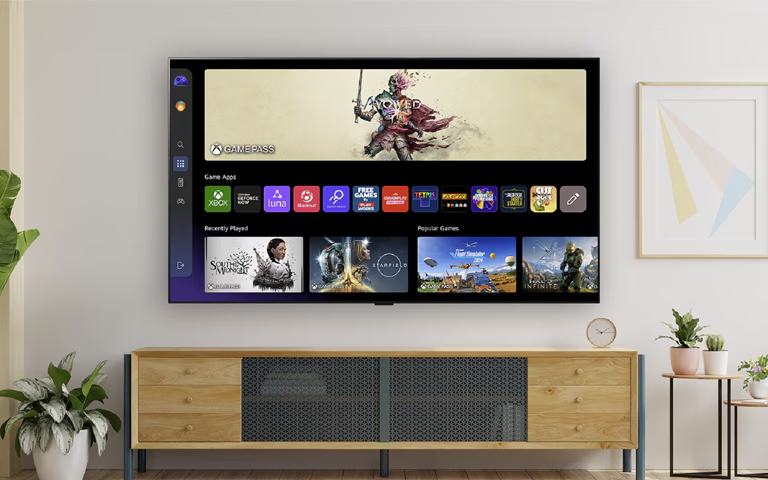
The test is available to Xbox Insiders only, for a defined test period, across Xbox consoles, select smart TVs, PCs, and mobile devices, according to Xbox Wire. As Kotaku noted, this is essentially the same thing Game Pass subscribers can already do without ads, now made available for free to those willing to sit through a preroll. The capability isn't new. What's new is who can access it, and at what price.
What Xbox free ad-supported cloud gaming actually includes
Each session runs up to one hour. Players can extend beyond that by watching another ad block, with up to two minutes of preroll per session, per The Hollywood Reporter via Kotaku. Ads play before the session starts and never during it. Microsoft lists "we do not interrupt the flow of gameplay" as one of six stated ad principles, per Xbox Wire.
The full list of those principles is worth spelling out, because it signals how carefully Microsoft is managing the optics of putting ads into a gaming context. Xbox Wire lists them as: ads should create value for the player; gameplay flow won't be interrupted; ads are held to the same quality bar as game content; what's advertising will be clearly labeled; ads will be appropriate for the platform; and the company will learn from the test and adjust based on player feedback. Microsoft frames the whole initiative as giving players "more affordable ways to play" rather than as a revenue experiment, though it's plainly both.
If you already hold a paid cloud gaming subscription, none of this applies. The ad-supported option is opt-in and invisible to existing subscribers, The Verge reported.
The access rules narrow the audience considerably. Participation requires an Xbox account, Insider enrollment, and a library of eligible owned titles. Someone who has never bought an Xbox game, or who lapsed years ago without keeping a library, gets nothing from this version of free. Which regions are "supported" hasn't been specified publicly, and the list of eligible game titles hasn't been released either. Those gaps make any precise assessment from the outside difficult right now.
The business logic: older hardware, lapsed users, and careful utilization limits
Microsoft has pointed to at least one target audience explicitly. Cloud gaming could "help Xbox One owners play newer games built for Xbox Series X/S" without buying a new console, The Verge reported. That framing is specific: users sitting on older hardware, with games in their library, who haven't upgraded and may not plan to. For that group, two minutes of preroll to access a Series X/S title they already own is a fairly straightforward trade.
The public test didn't materialize quickly. The Verge reported in January that Microsoft had been running internal tests since at least October of last year, with one-hour session limits and a cap of roughly five free hours per month, per The Verge's earlier reporting. The groundwork goes back further still: nearly a year ago, Xbox Wire announced that Game Pass Core and Standard subscribers gained the ability to stream owned games from supported devices, building the technical foundation the free tier now runs on.
The five-hour monthly ceiling from internal testing is worth sitting with. It suggests Microsoft was doing utilization math before any public announcement. Cloud compute and bandwidth carry real per-session costs, and two minutes of preroll ads offset a fraction of those expenses. Unlimited free sessions almost certainly wouldn't pencil out. From that angle, reading the structure of this test as anything other than a carefully bounded experiment would be a stretch. The hourly cap isn't a concession to player welfare; it's a cost management tool.
What that ad revenue actually covers, and whether the model can sustain itself at scale, remains unknown. Microsoft hasn't disclosed the economics, and the Insider test isn't designed to answer that question at any meaningful volume. It's designed to answer a narrower one first: will players watch a preroll? That behavioral data, completion rates, session lengths, device preferences, is what Microsoft needs before it can make a larger commitment.
The most plausible beneficiaries of the current test appear to be three distinct groups: lapsed Xbox users who own games but let their Game Pass subscription expire, Xbox One owners who want access to newer titles without a hardware investment, and occasional players who engage sporadically enough that a monthly subscription doesn't make financial sense for them. A newcomer with no Xbox library gets nothing here. This isn't an open acquisition play for that audience, at least not yet.
What the test can and can't tell Microsoft
The public version of this test is more limited than what Microsoft has reportedly explored internally. Earlier reporting from The Verge indicated that internal plans included streaming eligible Free Play Days titles over weekends and access to Xbox Retro Classics with preroll ads, neither of which is part of today's announcement, per The Verge's January report. Those features were described as part of internal testing plans, not confirmed future rollouts, so whether and when they arrive remains open.
That gap between what's been tested internally and what's now public is itself informative. Microsoft is running the most conservative version of the concept first: owned games only, Insiders only, limited time period, no catalog expansion. It's the floor, not the ceiling.
If ad completion rates hold up and session behavior stays within a sustainable utilization band, a logical next step would be widening the catalog to include retro titles and Free Play Days games. Each expansion reduces the owned-games barrier and broadens the potential user base. The step that would most meaningfully shift Xbox's competitive position, offering ad-supported access to games people don't already own, requires the unit economics to work at a substantially different scale. That's the version of this model that could genuinely function as an acquisition tool for new users rather than a re-engagement tool for existing ones.
The Insider test, by design, won't validate whether those economics work. It will generate behavioral signal on the easier question. Microsoft says it plans to iterate based on player behavior and feedback, per Xbox Wire, which is accurate, and also means the company controls what it learns from and what it chooses to share. For now, the bet is small and bounded: watch two minutes, play for an hour, tell us if you'd do it again. The answer to that question will determine how much further Microsoft is willing to push.



Comments
Be the first, drop a comment!