





Fox Acquisition of Roku: What Fox Promised About Your Apps
Fox's acquisition of Roku officially closed last week, on November 6, 2026. The same day, the Department of Justice closed its antitrust investigation into the merger, according to the DOJ's closing statement.
Roku ranks as the No. 1 TV streaming platform by hours streamed in the US, Canada, and Mexico, reaching more than 100 million households, according to Fox and Roku's original deal announcement earlier this year. Fox now owns the company behind your Roku device and platform.
Rather than issuing a consent decree or court order, the DOJ's closing statement describes its own competitive analysis alongside commitments Fox made about app carriage, search results, and partner data (DOJ, last week).
The DOJ statement presents these as commitments from Fox, not as terms of a court order or consent decree. It doesn't explain how compliance will be monitored or enforced. Below is what Fox actually said it would do, what it left unaddressed, and what Roku owners should keep an eye on.
What Fox owning Roku means for Roku users right now
The merger mechanics mostly restructured ownership and corporate paperwork. When Fox and Roku signed their agreement earlier this year, Roku shareholders were set to receive $96 in cash plus 0.9693 shares of Fox stock for each share they held, according to Fox and Roku's announcement. That's a shareholder transaction, not a software update.
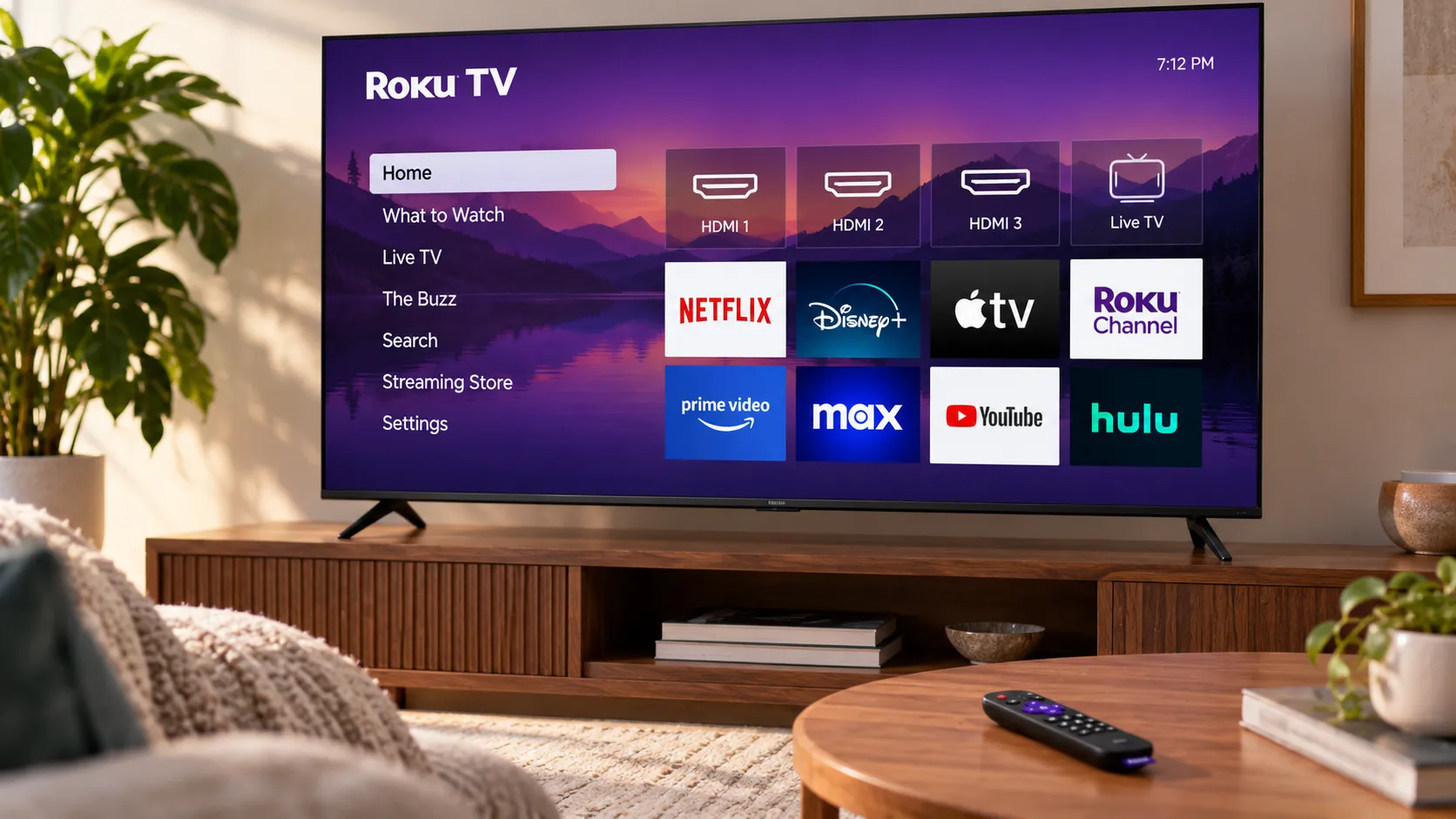
The closing itself doesn't announce any change to installed apps, channel lineups, or home-screen layouts. What's changed is who owns the company running Roku's platform, and what that company has publicly promised about how it will operate going forward.
Whether search results, app placement, or content promotion shift over time is a separate question, one the rest of Fox's commitments, and their gaps, start to answer.
What Fox actually committed to, and for how long
The DOJ's closing statement lists several specific commitments Fox made. They carry different scopes and expiration dates, so it's worth separating them rather than treating "Fox made commitments" as one uniform promise.
Fox committed to keep carrying non-Fox content on Roku for at least three years, consistent with how Roku has historically operated, according to the DOJ. That's the one carriage commitment with an explicit expiration date attached.
Separately, Fox committed not to discriminate against non-Fox content in search results, and to keep letting users rearrange app placement on the home screen. The DOJ's statement attaches no time limit to either of those two commitments.
Fox also committed to keep providing Roku's data products to third parties on commercially reasonable terms, with no stated expiration on that particular promise. A separate commitment covers existing contractual firewalls protecting competitively sensitive non-Fox partner data, including click, search, view, and voice data; that firewall commitment runs for at least three years, per the same DOJ statement.
The DOJ's statement doesn't identify a monitor, reporting process, penalty schedule, or any other compliance mechanism for these commitments.
What the DOJ statement doesn't address
The DOJ statement names two specific interface protections: search results and home-screen reconfiguration. It says nothing about featured banners, autoplay defaults, voice-assistant recommendations, push notifications, or how The Roku Channel's own programming gets promoted (DOJ).
That silence isn't proof those areas sit outside Fox's commitments, and it isn't proof they're fair game either. It's a question the public record doesn't answer, and readers shouldn't treat it as a confirmed loophole or a confirmed protection in either direction.
Fox Corporation CEO Lachlan Murdoch has told investors that content companies owning their own distribution is becoming standard across the industry, pointing to Fox's continued partnerships with YouTube, YouTube TV, and Comcast as evidence the company intends to keep existing distribution deals intact. "We're partners right now with YouTube, YouTube TV and Comcast, and that doesn't change," Murdoch said, according to Streaming Media Global, which covered the deal's closing yesterday.
Seeing Tubi or Fox One promoted more heavily in a banner, an autoplay slot, or a voice search result wouldn't necessarily break any commitment Fox has made publicly. A non-Fox app disappearing from Roku's lineup, or quietly losing visibility specifically in search results, would raise a far more direct question about whether Fox is honoring its stated promises.
Why Fox has business reasons to favor its own apps
Fox already competed with Roku before buying it. The company owns Tubi, a free ad-supported service that reports more than 110 million global monthly active users, plus Fox One and a sizable sports-rights and ad-sales operation, according to Streaming Media Global. Owning Roku now puts content, advertising, and distribution under one roof for the first time.
Audience overlap between Roku and Tubi currently sits around a third of their combined viewers, or roughly 86 million users, based on Ampere Analysis data cited by Streaming Media Global. Ampere describes a remaining audience gap of well over 100 million users, suggesting room for Fox to promote Tubi across the combined ecosystem, since the two services carry different content libraries. No specific cross-promotion plan has been announced.
Sports is another gap Fox could try to fill. Roku currently has little presence in sports streaming, while Fox One is built around sports rights. Ampere Analysis suggests Roku's international reach gives Fox a potential opening to pursue global sports rights it couldn't easily access through Fox One alone (Streaming Media Global).
Fox is also targeting roughly $400 million in run-rate cost synergies by the second full year after closing, a target set in Fox and Roku's original deal announcement earlier this year. That announcement doesn't specify which teams or functions would absorb those cuts, and that uncertainty matters for Roku's product and support staffing down the line. TD Cowen analyst Doug Creutz has flagged that risk directly, noting that "the history of content/platform mergers in media has generally not been kind," according to Streaming Media Global.
The DOJ's own reasoning cuts against Fox favoring its own apps too aggressively, though. The agency concluded that Roku depends on carrying a broad range of content providers to stay valuable to consumers, meaning self-preferencing would cause the combined company real monetary and reputational damage. It also noted that if Fox degraded the Roku experience, consumers could migrate to rival connected-TV platforms, which Streaming Media Global's coverage names as Amazon Fire TV, Google TV, and Samsung TV Plus (DOJ; Streaming Media Global).
What Roku owners should actually watch
The public record doesn't point to a documented software or app change today, so current Roku owners don't have a specific action to take right now. The DOJ's commitments cover carriage, search results, home-screen rearrangement, and certain partner-data protections, nothing more and nothing less than that.
Watch for these signs instead:
- Whether a non-Fox app you rely on disappears from Roku's lineup or drops out of carriage entirely.
- Whether that app's visibility in search results noticeably worsens over time.
- Whether you can still freely rearrange apps on your home screen, one of the two commitments without a stated expiration date.
- Whether partner data practices, especially the click, search, view, and voice data firewalls, change in ways third-party apps publicly flag.
Heavier promotion of Tubi or Fox One in banners, autoplay, or voice results wouldn't by itself confirm a broken promise, since the DOJ statement doesn't name those surfaces either way. Dropped carriage or degraded search placement for apps you actually use would be the clearer signal, and that's the behavior worth watching for in independent reporting over the coming months.

Comments
Be the first, drop a comment!