



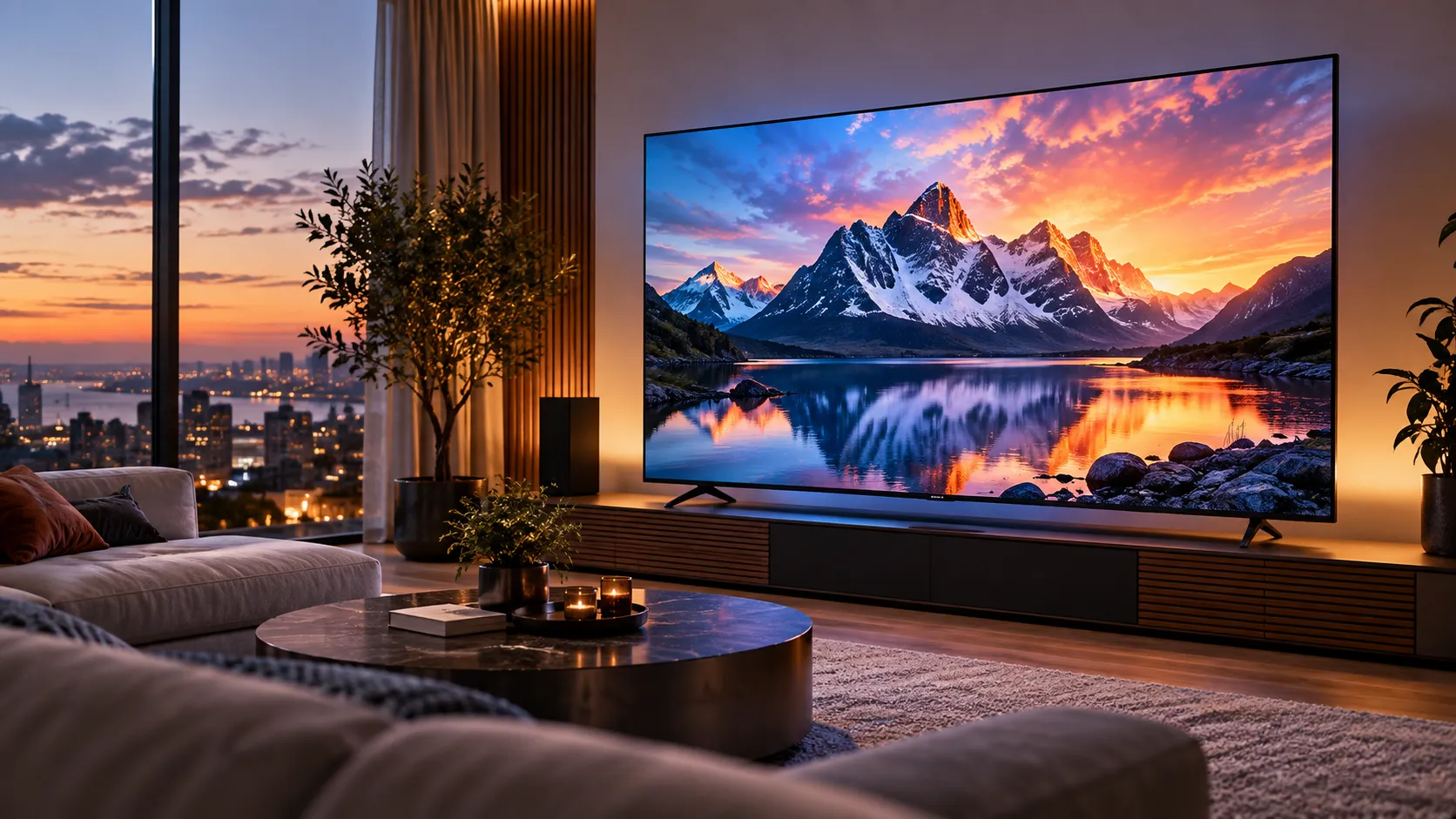
Buying a TV with the IMAX Enhanced badge doesn't automatically make every movie look bigger or sound better. What you get depends on the title, streaming service and hardware in the playback chain.
So what is IMAX Enhanced, in plain terms? It's a certification and licensing program operated by IMAX and DTS that combines specially prepared content with devices designed to meet IMAX's picture and sound standards.
Depending on the title, that can include a taller picture, IMAX-optimized mastering and immersive DTS:X audio.
The distinction that matters most for TV shoppers is simple: you do not need an IMAX Enhanced-certified TV to see Disney+'s taller IMAX framing. Disney+ says its expanded aspect ratio works on any supported device. The DTS:X audio feature has much narrower hardware requirements.
What IMAX Enhanced actually is, and what it isn't
Think of IMAX Enhanced as an ecosystem rather than a single format like Dolby Vision or Dolby Atmos.
IMAX describes the program as combining specially remastered or optimized content with certified consumer devices. Certification covers performance standards for areas such as resolution, brightness and sound fidelity.
On the content side, the most visible feature is often IMAX's expanded aspect ratio. Supported movies can use a taller 1.90:1 frame instead of the wider 2.39:1 presentation common in theatrical releases.
The audio component is IMAX Enhanced sound by DTS:X, which uses DTS:X to reproduce an immersive version of the theatrical mix.
That makes the pieces different from technologies readers may already recognize:
IMAX Enhanced can include expanded framing, IMAX picture mastering and DTS:X audio.
Dolby Vision is a dynamic HDR format that adjusts picture information scene by scene.
Dolby Atmos is an immersive audio format separate from IMAX Enhanced sound.
Those technologies are not automatically mutually exclusive. The HDR format, aspect ratio and available audio tracks depend on the specific movie, service and device.
Certified TVs can also include an IMAX Enhanced picture mode. Sony's current support documentation, for example, lists an IMAX Enhanced picture mode on supported BRAVIA models.
IMAX Enhanced on TV: the picture benefit vs. the audio requirement
The easiest IMAX Enhanced feature to access is the expanded picture.
Disney+ says supported IMAX Enhanced movies use a 1.90:1 aspect ratio that can reveal up to 26% more of the original image than the standard widescreen presentation.
You do not need an IMAX Enhanced-certified TV for that. According to Disney+'s current IMAX Enhanced guidance, all supported Disney+ devices can display the expanded aspect ratio on eligible titles.
Some movies use the taller frame for the entire runtime, while others switch into it only for particular sequences. Disney+ lets users check the Versions tab on supported titles to see whether both IMAX Enhanced and standard widescreen presentations are available.
Audio is much more restrictive.
Disney+ currently supports IMAX Enhanced sound with DTS:X only on select Android TV devices from Sony, Hisense, Sharp and Xiaomi. The title itself must also offer DTS:X.
To check, open the movie's Details tab. Disney+ displays a DTS:X badge when IMAX Enhanced sound is available for that title and device.
Disney+ also requires users to enable IMAX Enhanced sound during playback. Open the player controls, select Audio Options and turn on IMAX Enhanced sound with DTS:X. If the device does not support it, the option will not appear.
Subscribers should also check their Disney+ plan. Disney says its ad-supported plans currently do not include Dolby Atmos or IMAX Enhanced sound.
Do you need an IMAX Enhanced TV?
For most buyers, no.
If the main goal is watching Disney+ movies in the expanded 1.90:1 aspect ratio, IMAX Enhanced certification is unnecessary. A supported Disney+ device can display that version whether the TV carries the badge or not.
Certification becomes more relevant when buying a TV as part of a larger home-theater setup or when you specifically want IMAX-calibrated picture modes and compatible DTS:X playback.
Even then, do not assume the badge on one component guarantees the entire setup will work.
For Disney+ DTS:X playback, the TV must be one of the supported Android TV devices. If audio is being sent to an external soundbar or AV receiver, that device also needs to support the DTS:X signal.
Sony, for example, maintains a current list of BRAVIA models that support Disney+ DTS:X. Its 2026 list includes BRAVIA 9 II and BRAVIA 7 II, along with selected models from 2023 through 2025.
That is more useful than relying on a generic IMAX Enhanced badge because streaming-service support can be narrower than the certification program itself.
Where to watch IMAX Enhanced content
Disney+ is the most straightforward mainstream example because it separates the expanded picture from the more demanding DTS:X audio requirements.
The service offers an IMAX Enhanced filter for finding supported movies. Individual titles can also include a Versions tab for switching between the expanded presentation and standard widescreen.
Disney+'s IMAX Enhanced catalog has continued to expand beyond the original Marvel rollout. DTS announced in September that Star Wars: The Mandalorian and Grogu became the first Star Wars movie available through Disney+ in IMAX Enhanced.
Sony Pictures Core is another major source. Sony currently promotes it as having its largest collection of IMAX Enhanced movies, with supported titles available on eligible BRAVIA televisions and Sony devices.
On compatible BRAVIA TVs, Sony Pictures Core combines IMAX Enhanced movies with Pure Stream, which can stream supported 4K HDR content at up to 80 Mbps.
Availability still depends heavily on region and hardware. IMAX's own filings identify Disney+, Sony Pictures Core and Tencent Video among services carrying IMAX Enhanced content, while other platforms and catalogs vary by market.
Physical releases are less dependable if the goal is specifically an IMAX Enhanced presentation. Some UHD Blu-ray movies include expanded IMAX sequences, but the IMAX Enhanced streaming version of a movie is not automatically reproduced on its disc release.
What the IMAX Enhanced badge does tell you
The badge still has value. It means the product has gone through the IMAX and DTS certification program rather than a manufacturer simply using "IMAX" as a marketing description.
IMAX's certification program evaluates devices against performance requirements intended to preserve the picture and sound characteristics of IMAX Enhanced content.
Current certified-device partners include major TV manufacturers such as Sony, Hisense, TCL, LG and Philips. Audio hardware carrying compatible DTS:X or IMAX Enhanced support is also available from brands including Denon, Marantz and JBL.
That does not mean every certified TV supports every IMAX Enhanced feature on every streaming service. Disney+'s DTS:X restrictions are a good example: its supported-device list remains considerably narrower than the overall IMAX Enhanced hardware ecosystem.
The badge is therefore better treated as a compatibility and quality indicator than as a feature that automatically activates whenever a movie starts.
What to check before you buy or rely on it
Start with the feature you actually want.
If it's the taller picture on Disney+, you do not need a certified TV. Choose an IMAX Enhanced version of a supported movie and Disney+ can display the expanded aspect ratio on any supported device.
If you want IMAX Enhanced sound, check the hardware more carefully. Disney+ currently requires a supported Android TV device from Sony, Hisense, Sharp or Xiaomi, a title carrying the DTS:X badge and a compatible audio path.
If an external soundbar or AV receiver is involved, make sure it supports DTS:X and that the TV can pass the required signal to it.
For Sony Pictures Core or another service, verify support against that service's current device list rather than assuming Disney+'s rules apply everywhere.
Most shoppers should not choose a TV for the IMAX Enhanced badge alone. Panel quality, HDR performance, gaming features, operating system and price will usually matter more day to day.
If two otherwise comparable TVs are already on the shortlist, IMAX Enhanced support can be a useful extra. Just remember that the expanded picture, certified picture modes and DTS:X sound are separate pieces, and owning one certified device does not guarantee all three.






Comments
Be the first, drop a comment!