



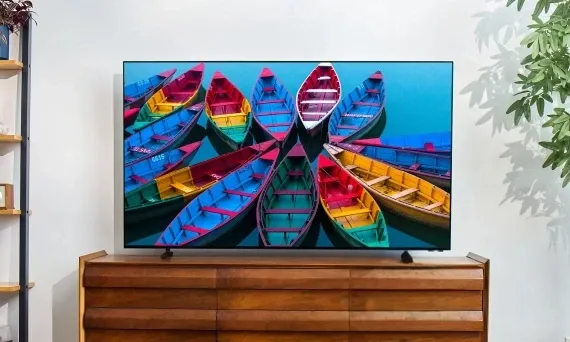
Roku entered the OLED television market for the first time on September 1, 2026, with two new sets priced well below what LG and Samsung charge for comparable screens. The Roku Pro Series OLED TV starts at $999 for a 55-inch model and is available now, while the higher-end Roku Pro Series LX OLED TV starts at $1,299 and ships in October.
That $999 price is $1,000 below the 55-inch LG C6's $1,999.99 MSRP and about $300 below LG's current discounted price of $1,299.99. Even the pricier LX costs no more than a discounted C6. Flagship OLEDs from Samsung and LG still start above $2,000 for a 55-inch screen and climb toward $3,000 at 65 inches, according to the same report.
Both sets share a thin-bezel design with ports tucked into the lower two-thirds of the panel and built-in cable management on the back. Roku describes the OLED panels as delivering vibrant color and true blacks with wide viewing angles. Both models are Amazon exclusives at launch, so shoppers loyal to Best Buy, Walmart, or Target will have to wait or look elsewhere.
What the $999 and $1,299 prices cover
The standard Pro Series OLED is available now in 55-inch and 65-inch sizes. Roku says the 4K 120Hz panel offers wide viewing angles and supports Dolby Vision, Smart Picture Max scene tuning, and an Automatic Game Mode that detects gameplay and enables variable refresh rate and AMD FreeSync Premium. It ships with a backlit, battery-powered Roku Voice Remote.
The LX won't ship until October. Roku now lists the 55-inch model at $1,299.99 and the 65-inch model at $1,599.99, resolving an early discrepancy in launch-day coverage over what size the starting price covered. Roku's own description promises "a brighter picture," a 144Hz refresh rate, and an advanced polarizer to cut reflections, without further detail on sizing.
Neither model has been announced above 65 inches. That's not necessarily a hard ceiling: Roku's separate mini-LED Pro Series already reaches 75 inches, and its Select Series line goes up to 85 inches. Whether the OLED lineup ever follows is an open question, not a confirmed plan.
Standard OLED vs. LX: what's confirmed, what isn't
Pro Series OLED
Price: $999 for 55-inch model; also available in 65 inches
Refresh rate: 4K at 120Hz
Brightness: Not specified
Reflection handling: Not specified
Remote: Battery-powered backlit remote
Shared software/features: Smart Picture Max, Automatic Game Mode, Dolby Vision, VRR, and FreeSync Premium
Pro Series LX OLED
Price: $1,299.99 (55"); $1,599.99 (65")
Refresh rate: Up to 144Hz VRR
Brightness: Brighter panel; no nit figure provided
Reflection handling: Advanced polarizer
Remote: Rechargeable Voice Remote Pro
Shared software/features: Smart Picture Max, Automatic Game Mode, Dolby Vision, VRR, and FreeSync Premium
The announced differences on the LX are a higher refresh rate, an added anti-reflection layer, and a rechargeable remote instead of a battery-powered one. Roku also promises "a brighter picture" on the LX but hasn't attached a peak-brightness figure to either model, a gap that matters because brightness largely determines how well HDR content looks on screen.
For context on why that number matters: PCMag notes that 2020's Vizio OLED-H1 measured just over 500 nits in a 10% window, while the Editors' Choice Samsung S95H and LG Evo G6 exceed 1,500 nits in an 18% field and top 2,200 nits in a 10% field. That's a wide gap between a passable OLED and a genuinely bright one. Without a spec from Roku, "brighter" is a promise rather than a number buyers can compare.
PCMag says it hasn't run either Roku set through lab testing yet, with reviews expected in the coming weeks. Until then, the panel performance behind Roku's aggressive pricing is unverified.
Roku OLED TV software: why it matters
Software is the one piece of this launch Roku fully controls, and the company frames it as the throughline of its TV strategy. "Since launching our first Roku-made TVs two years ago, we've focused on creating products that marry our easy-to-use software with thoughtfully designed hardware," said Paul Nangeroni, Roku's senior director of product management, in an announcement about the company's TV strategy. The Pro Series OLED and LX OLED are the first OLED sets to carry that software.
PCMag's reviewer recommends Roku OS above other smart TV platforms for older users and anyone who isn't particularly tech-savvy, and notes that OLED sets running Roku's interface have been scarce until now. Roku describes itself as the top-selling TV operating system in the U.S., Canada, and Mexico, a figure that comes from the company's own reporting rather than independent measurement.
An established interface paired with an unproven panel is the wager Roku is making with this launch.
What still needs to be answered
Roku's $999 starting price sits well below the LG models PCMag cites, and the announced feature set spans 120Hz to 144Hz refresh rates, VRR, and Dolby Vision across both models. That much is settled.
What isn't: Peak brightness in nits on either model, which Roku hasn't disclosed; and how the panels handle HDR tone-mapping and reflections in practice rather than on a spec sheet. Roku's broader made-for-TV lineup already sells through Best Buy, Walmart, and Target alongside Amazon, but that wider distribution hasn't extended to either new OLED model yet.
PCMag's lab results, due in the coming weeks, should settle most of it. The October LX launch should provide the first opportunity to judge its real-world performance. Roku has proven it can price an OLED TV well below LG's comparable models. Whether the picture holds up is still an open question.



Comments
Be the first, drop a comment!